
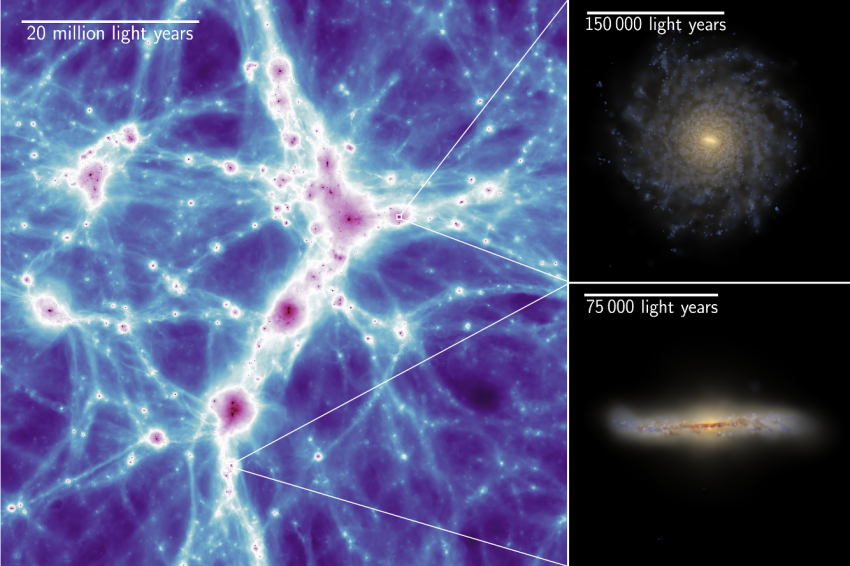

The most realistic picture yet of how galaxies formed and then evolved from the beginning of time has been revealed in a suite of new and unique audiovisual simulations.
This data, published today in Monthly Notices of the Royal Astronomical Society, shows that the standard cosmological model can successfully explain the observed growth of galaxies, from the first billion years after the Big Bang to the present day, when key physics is included.
Unlike earlier simulations, the COLIBRE 'virtual universes' model the cold gas and cosmic dust inside galaxies – the raw materials from which stars form and which strongly affect how galaxies look in telescopes.
By including these previously missing ingredients and using far more computing power than ever before, the simulations successfully reproduce real galaxies, both in the present-day universe and in the early universe as seen by the James Webb Space Telescope (JWST).
"Much of the gas inside real galaxies is cold and dusty, but most previous large simulations had to ignore this," said project leader Professor Joop Schaye, of Leiden University. "With COLIBRE, we finally bring these essential components into the picture."
The results show that our standard model of the universe can explain galaxy formation more accurately than previously thought, while also opening up powerful new ways to compare theory with observations and to explore a virtual universe through visuals, sound, and interactive tools.
Digital cold gas and dust grains
According to the international team of researchers, their COLIBRE simulations break new ground in several ways. Earlier simulations artificially prevented gas inside galaxies from cooling below about 10,000 degrees Fahrenheit – hotter than the surface of the Sun – because modelling colder gas was too complex. Yet, observations show that stars form in cold gas. COLIBRE includes the additional physical and chemical processes needed to model this cold interstellar gas directly.
COLIBRE also simulates small dust grains, which can greatly influence galactic gas. These solid particles can help hydrogen molecules to form, which dominate the cold gas content of galaxies. The dust also shields gas from harsh ultraviolet radiation and strongly affects how galaxies appear in telescopes. Dust absorbs ultraviolet and optical light from stars and re-emits it in the infrared, shaping many astronomical observations. By modelling dust directly, COLIBRE opens new ways to compare simulations with real data.
Thanks to advances in algorithms and supercomputing, COLIBRE uses up to 20 times more resolution elements than earlier simulations, allowing larger volumes to be simulated in greater detail and with better statistics.
A new laboratory
COLIBRE demonstrates that realistic treatments of cold gas, dust, and outflows driven by stars and black holes are crucial for understanding galaxy evolution, the researchers say. It provides a powerful new laboratory for testing theories, interpreting observations, and creating "virtual observations" to check how astronomers analyse real data.
The findings also show that the standard cosmological model remains consistent with observations of galaxy evolution, including some that were thought to be challenging, such as the masses of galaxies in the early universe.
"Some early JWST results were thought to challenge the standard cosmological model," said Dr Evgenii Chaikin, of Leiden University, lead author of several accompanying COLIBRE papers and co-author of the main study.
"COLIBRE shows that, once key physical processes are represented more realistically, the model is consistent with what we see."
Still, not everything has been explained yet. The enigmatic 'Little Red Dots' discovered by JWST, possibly the seeds of supermassive black holes, are not predicted by COLIBRE, which assumes such seeds already exist. Modelling their formation will require even higher resolution simulations and new physics, pointing the way for future work.
The simulations were run using the SWIFT simulation code on the COSMA8 supercomputer at the Institute for Computational Cosmology at Durham University, which is hosted on behalf of the DiRAC national facility in the UK. The largest simulation required 72 million CPU hours, and the full model took nearly 10 years to develop by an international team spanning Europe, Australia, and the United States.
Carlos Frenk, Ogden Professor of Fundamental Physics at the Institute for Computational at Durham University, and a core member of the COLIBRE team said: "It is exhilarating to see 'galaxies' come out of our computer that look indistinguishable from the real thing and share many of the properties that astronomers measure in real data such as their number, luminosities, colours and sizes.
"I like to tease my observer colleagues by asking 'which galaxy catalogue do you think these images came from?'"
He added: “What is most remarkable is that we are able to produce this synthetic universe purely by solving the relevant equations of physics in the expanding universe.”
The scientists point out that it will take years to analyse the data that has already been produced. Most simulations were completed in 2025, although some of the simulations with the highest resolution are still running and are expected to finish after the summer.
A universe you can see and hear
Beyond traditional data products, the team has developed new ways to explore the simulations. This includes "sonified videos", where sound encodes additional physical information, as well as interactive maps that allow users to explore the virtual universes.
"We're excited not just about the science, but also about creating new ways to explore it," said Dr James Trayford, of the University of Portsmouth, who led the development of COLIBRE's dust model and the sonification of its visualisations.
"These tools could provide new insights, make our field more accessible, and help us build intuition for how galaxies grow and evolve."
ENDS
Media contacts
Sam Tonkin
Royal Astronomical Society
Mob: +44 (0)7802 877 700
Science contacts
Joop Schaye
Leiden Observatory, Leiden University
Evgenii Chaikin
Leiden Observatory, Leiden University
James Trayford
Institute of Cosmology and Gravitation, University of Portsmouth
Professor Carlos Frenk
Durham University
Images & video
Images, videos, and interactive material from the COLIBRE simulations are available at:
https://colibre-simulations.org
Media, developed using COLIBRE, can be found here: sonified videos, interactive sliders, and interactive maps.
Further information
The paper ‘The COLIBRE project: cosmological hydrodynamical simulations of galaxy formation and evolution’ by Schaye et al. has been published in Monthly Notices of the Royal Astronomical Society. DOI: 10.1093/mnras/stag375.
The paper ‘COLIBRE: calibrating subgrid feedback in cosmological simulations that include a cold gas phase’ by Chaikin et al. has been published in Monthly Notices of the Royal Astronomical Society. DOI: 10.1093/mnras/stag300.
Notes for editors
About the COLIBRE collaboration
The COLIBRE collaboration is an international team led by Professor Joop Schaye, of Leiden University. It includes researchers from the UK (Durham University, Portsmouth, Hull, Liverpool John Moores, Nottingham), Austria (University of Vienna), Italy (University of Milano-Bicocca), Australia (University of Western Australia), Belgium (University of Ghent) and the US (University of Pennsylvania).
A team of several Durham physicists at the Institute for Computational Cosmology contributed to the design and execution of the simulations and to the scientific analysis of the data. Members of this team wrote key elements of the software used for the simulations and helped run them on the "COSMA" supercomputer at Durham. Members of the team are leading major sub-projects analysing the simulation results and comparing them to observed data.
About NOVA
The Netherlands Research School for Astronomy (NOVA, www.astronomie.nl) is the alliance of the astronomical institutes of the universities of Amsterdam, Groningen, Leiden, and Nijmegen. The mission of Top Research School NOVA is to carry out frontline astronomical research in the Netherlands, to train young astronomers at the highest international level, and to share its new discoveries with society. The NOVA laboratories are specialised in building state-of-the-art optical/infrared and submillimeter instrumentation for the largest telescopes on earth.
About the Royal Astronomical Society
The Royal Astronomical Society (RAS), founded in 1820, encourages and promotes the study of astronomy, solar-system science, geophysics and closely related branches of science.
The RAS organises scientific meetings, publishes international research and review journals, recognises outstanding achievements by the award of medals and prizes, maintains an extensive library, supports education through grants and outreach activities and represents UK astronomy nationally and internationally. Its more than 4,000 members (Fellows), a third based overseas, include scientific researchers in universities, observatories and laboratories as well as historians of astronomy and others.
The RAS accepts papers for its journals based on the principle of peer review, in which fellow experts on the editorial boards accept the paper as worth considering. The Society issues press releases based on a similar principle, but the organisations and scientists concerned have overall responsibility for their content.
Keep up with the RAS on Instagram, Bluesky, LinkedIn, Facebook and YouTube.
Download the RAS Supermassive podcast